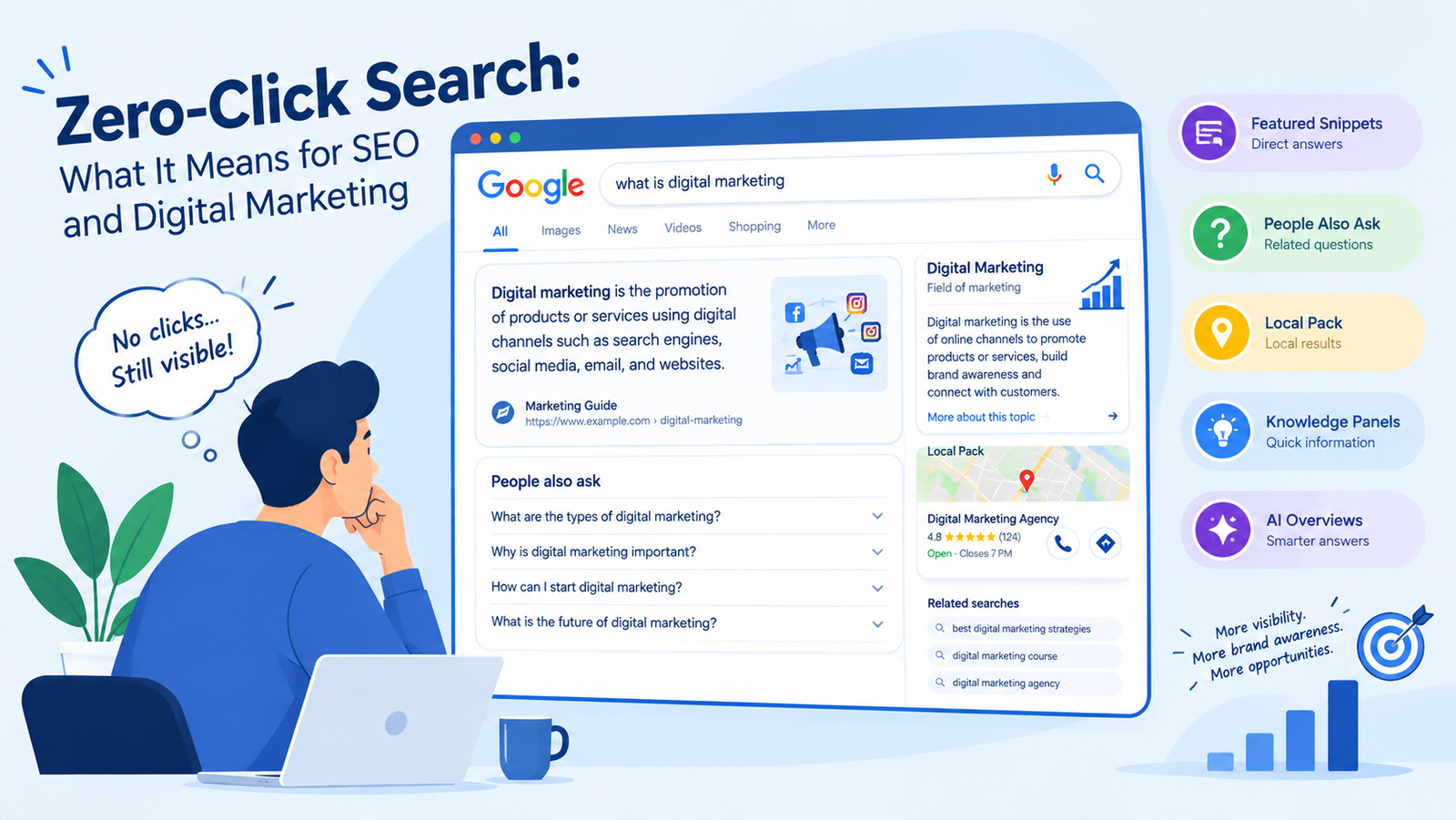
Zero-Click Search: What It Means for SEO and Digital Marketing
- By Admin
- |
- 0 Comments
Search engines have changed significantly in recent years. People no longer use Google only to find a website, click a link, and then search for an answer. Today, search engines can provide answers directly on the search results page through featured snippets, People Also Ask, local results, knowledge panels, and AI-powered search experiences.
This change has introduced an important concept in modern SEO: zero-click search.
A zero-click search occurs when a user finds the information they need directly on the search engine results page without clicking on a website.
For businesses and digital marketers, this creates both a challenge and an opportunity. Website traffic is still important, but appearing prominently in search results has become an important part of building online visibility and brand awareness.
In this article, we will understand what zero-click search means, how it affects SEO and digital marketing, its impact on website traffic, and how businesses can optimize their online presence for the changing search landscape.
What Is Zero-Click Search?
A zero-click search is a search query where a user gets the information they are looking for directly from the search engine results page without visiting another website.
For example, a person may search for:
- What is digital marketing?
- What is SEO?
- Weather today
- How many grams are in a kilogram?
- Digital marketing agency near me
Depending on the query, Google may display the required information directly in the search results.
For informational searches, users may see a short definition, featured snippet, related questions, business information, maps, or other search features without needing to click a traditional organic result.
This is why modern SEO is no longer only about getting a website to rank number one. Businesses also need to think about how their brand appears and provides value within the search results themselves.
How Does Zero-Click Search Work?
Search engines try to understand the intent behind a user's search query and provide the most useful information as quickly as possible.
Depending on the search query, the results page may contain several different features.
1. Featured Snippets
Featured snippets display a direct answer from a webpage at the top of the search results.
For example, if someone searches for "What is SEO?", the search engine may display a short definition before the traditional organic results.
Appearing in this position can give a website strong visibility, even if the user does not click through to the website.
2. People Also Ask
The People Also Ask section displays related questions that users may want to know about.
For example, after searching for "digital marketing," users may see questions such as:
- What are the types of digital marketing?
- Why is digital marketing important?
- How does digital marketing work?
Creating useful content that directly answers relevant questions can help businesses improve their chances of appearing in these search features.
3. Knowledge Panels
Knowledge panels provide information about businesses, people, organizations, and other entities directly in search results.
They can include information such as descriptions, websites, locations, contact details, and other relevant information.
For businesses, maintaining accurate and consistent information across their online presence can support better search visibility.
4. Local Search Results
Local searches are another important example of zero-click search behavior.
A user searching for:
"digital marketing agency near me"
may see businesses, locations, reviews, contact options, and directions directly within the search results.
This makes local SEO particularly important for businesses that depend on customers from specific cities or areas.
5. AI-Powered Search Experiences
Search is also becoming more conversational and AI-assisted.
Users can increasingly receive summarized answers to complex questions instead of having to visit several different websites.
As search experiences evolve, businesses need to focus not only on ranking for keywords but also on providing reliable, useful, and well-structured information that search engines can understand.
Why Is Zero-Click Search Important for SEO?
Traditional SEO has often followed a simple process:
Higher Rankings → More Clicks → More Website Traffic
Zero-click search adds another important element:
Search Visibility → Brand Awareness → Trust → Relevant Traffic → Conversions
A business can benefit from appearing prominently in search results even when every search impression does not result in a website visit.
For example, a potential customer may see a company's name while searching for information today and remember that brand later when they are ready to purchase a product or service.
Therefore, search visibility can contribute to brand awareness and recognition even when the immediate click-through rate is low.
Zero-Click Search and Digital Marketing
Zero-click search is not only an SEO topic. It also affects the broader digital marketing strategy of a business.
Digital marketing includes several channels, such as:
- Search engine optimization
- Content marketing
- Social media marketing
- Paid advertising
- Email marketing
- Local marketing
- Brand marketing
Search visibility connects many of these activities.
For example, a strong content marketing strategy can help a business answer questions that potential customers are searching for. SEO can make that content discoverable, while strong branding can help users remember the business after seeing it in search results.
This creates an important shift in digital marketing.
Businesses should not focus only on generating immediate clicks. They should also focus on creating consistent visibility throughout the customer's search journey.
Zero-Click Search vs Traditional SEO
Traditional SEO generally focuses on rankings, organic traffic, backlinks, and conversions.
Zero-click SEO adds another important objective: visibility within the search results page.
| Traditional SEO | Zero-Click SEO |
|---|---|
| Focuses heavily on website traffic | Focuses on both visibility and traffic |
| Targets organic rankings | Targets rankings and SERP features |
| Measures clicks | Measures impressions, visibility, and clicks |
| Primarily drives users to websites | Can provide information directly in search |
| Focuses mainly on traditional results | Considers snippets, local results, PAA, and other search features |
This does not mean traditional SEO is becoming irrelevant.
Instead, modern SEO should combine search visibility, relevance, authority, traffic, and conversions.
How Zero-Click Searches Affect Website Traffic
One of the biggest concerns surrounding zero-click search is its potential impact on organic website traffic.
If a user gets an answer directly from the search results page, they may have less reason to visit a website.
However, this does not mean that website traffic is no longer important.
Websites remain essential for:
- Detailed information
- Product purchases
- Service bookings
- Lead generation
- Contact information
- Case studies
- Resources and guides
- Brand credibility
- Conversions
The goal should not be to avoid zero-click searches.
Instead, businesses should create content that provides useful information in search while also giving users a reason to visit the website for deeper information, products, services, tools, or solutions.
How to Optimize for Zero-Click Search
Businesses can adapt their SEO strategies to improve their chances of appearing prominently in search results.
1. Understand Search Intent
Before creating content, understand what the user actually wants.
For example, if someone searches:
"What is SEO?"
They are probably looking for a simple explanation.
However, if someone searches:
"How to improve SEO for a small business?"
They are looking for practical strategies and actionable advice.
Understanding search intent helps businesses create content that directly satisfies the user's needs.
2. Provide Clear and Concise Answers
For informational content, provide a direct answer before going into detailed explanations.
Use:
- Short paragraphs
- Bullet points
- Numbered lists
- Clear definitions
- Question-based headings
- Easy-to-understand language
This makes content easier for both users and search engines to understand.
3. Use Question-Based Headings
Question-based headings can naturally match the way people search.
For example:
- What is zero-click search?
- Why is zero-click search important?
- How does zero-click SEO work?
- How can businesses optimize for zero-click searches?
- Does zero-click search reduce website traffic?
Each question should be answered accurately and thoroughly.
4. Build Topical Authority
Creating a single article is rarely enough to establish strong authority around a topic.
For example, a digital marketing website can create related content about:
- SEO
- Keyword research
- Technical SEO
- Content marketing
- Local SEO
- Search intent
- SERP features
- AI search
- Digital advertising
Creating connected and useful content around a subject can help establish stronger topical relevance.
5. Optimize for Local Search
Local businesses should pay particular attention to zero-click search behavior.
Users may search for:
"SEO agency near me"
or
"digital marketing agency in Jaipur"
A well-optimized local presence can help businesses appear when users are searching for nearby products and services.
Important areas of local SEO include:
- Accurate business information
- Google Business Profile optimization
- Local keywords
- Customer reviews
- Consistent business information
- Location-focused content
For businesses that depend on local customers, local SEO should be an important part of the overall digital marketing strategy.
6. Strengthen Your Brand Presence
Zero-click search also makes brand recognition increasingly important.
Imagine a user repeatedly sees the same company when searching for topics related to its industry.
Even if the user does not click immediately, repeated exposure can increase familiarity with the brand.
Businesses should therefore maintain consistent branding across:
- Websites
- Search results
- Social media
- Business listings
- Online directories
- Content platforms
SEO and branding should work together instead of being treated as completely separate strategies.
7. Use Structured and Organized Content
Well-organized content is easier for both users and search engines to understand.
Use a clear heading structure such as:
H1 → H2 → H3
Also make appropriate use of:
- Lists
- Tables
- FAQs
- Definitions
- Step-by-step instructions
Where relevant, businesses can also use structured data to help search engines better understand the content and information available on their webpages.
8. Focus on Content Quality
Trying to optimize every sentence only for keywords can make content difficult and unnatural to read.
Instead, focus on:
Useful information + Search intent + Clear structure + Expertise + Originality
Keywords should appear naturally where they make sense.
The objective should be to answer the user's question effectively rather than repeatedly inserting the same keyword.
How Should Businesses Measure Zero-Click SEO?
Measuring SEO success only through website sessions is becoming less useful.
Businesses should consider a broader range of SEO metrics.
Search Impressions
Search impressions show how often your content appears in search results.
Average Position
Average position provides an indication of how prominently your website appears for relevant search queries.
Click-Through Rate
Click-through rate measures how frequently users click on your result after seeing it in search.
Branded Searches
Businesses can monitor whether more people are searching specifically for their brand name.
Organic Traffic
Organic traffic remains an important metric for understanding how many relevant users are visiting the website from search engines.
Conversions
Ultimately, businesses should also measure whether search visibility leads to meaningful actions such as:
- Leads
- Purchases
- Appointment bookings
- Sign-ups
- Phone calls
- Enquiries
The most important metrics depend on the individual goals of the business.
Common Zero-Click SEO Mistakes
Businesses can make several mistakes when adapting to zero-click search.
Mistake 1: Focusing Only on Rankings
Ranking is important, but rankings alone do not guarantee business success.
Visibility, relevance, traffic, engagement, and conversions should also be considered.
Mistake 2: Writing Only for Search Engines
Content should primarily be created for people.
If content is difficult to read or does not provide useful information, ranking alone will not create a strong user experience.
Mistake 3: Ignoring Search Intent
A webpage can rank for a keyword but still fail to satisfy the user's actual needs.
Understanding search intent should therefore be a key part of content planning.
Mistake 4: Ignoring Local SEO
Local businesses can miss valuable opportunities if they focus only on broad, highly competitive keywords.
Local search visibility can be extremely important for service-based businesses.
Mistake 5: Giving Information Without Providing Further Value
Businesses should answer questions clearly, but they should also provide additional value through detailed guides, tools, examples, products, services, or resources.
This gives users a reason to explore the website when they need more information.
Does Zero-Click Search Mean SEO Is Dead?
No, SEO is not dead. SEO is evolving.
Search engines are becoming better at understanding questions, context, entities, and user intent. At the same time, users expect faster and more useful answers.
This means businesses need to move away from a narrow mindset of:
"How do I rank number one?"
and start thinking about:
"How can my brand become the most useful and trusted result for this search?"
SEO remains important because search engines still need reliable information, while websites continue to be essential for products, services, detailed content, and conversions.
The Future of Zero-Click Search
Search will likely continue becoming more conversational, visual, personalized, and AI-assisted.
Users may increasingly ask complex questions instead of entering short keyword phrases.
For digital marketers, this means future content strategies will need to focus more strongly on:
- Search intent
- Topic authority
- Original information
- Brand credibility
- Structured content
- Local relevance
- User experience
- Multichannel visibility
The future of SEO will not simply be about getting a website to rank.
It will be about making a brand discoverable, understandable, trustworthy, and useful throughout the search experience.
Final Thoughts
Zero-click search represents an important change in how users interact with search engines.
A user may discover your brand, read your answer, see your business information, or become familiar with your expertise without immediately visiting your website.
That does not make SEO less valuable. Instead, it means that the definition of SEO success is becoming broader.
Businesses that focus on useful content, search intent, strong brand visibility, local SEO, technical quality, and trustworthy information can adapt more effectively to the changing search landscape.
The key takeaway is simple:
In modern SEO, winning the search result is not always about getting the click. Sometimes, being the brand users see and remember is the first step toward earning the customer.
Frequently Asked Questions
What is zero-click search?
Zero-click search refers to a search where users find the information they need directly on the search results page without clicking on a website.
Is zero-click search bad for SEO?
Not necessarily. Although it can reduce clicks for some informational searches, appearing prominently in search can increase brand visibility, awareness, and trust.
What is zero-click SEO?
Zero-click SEO is an approach that focuses on gaining visibility within search results through features such as featured snippets, People Also Ask, local results, knowledge panels, and other SERP elements.
How can I optimize my website for zero-click searches?
Create clear and useful content that matches search intent, answer common questions directly, structure your content properly, build topical authority, and optimize your local presence where relevant.
Will zero-click searches replace traditional SEO?
No. Traditional SEO remains important, but businesses need to expand their strategy beyond rankings and website clicks to include search visibility, brand recognition, and overall online presence.
Why is zero-click search important for digital marketing?
Zero-click search is important because users can interact with search results without visiting a website. Digital marketers therefore need to consider visibility and brand exposure alongside traffic, leads, and conversions.
- Digital marketing