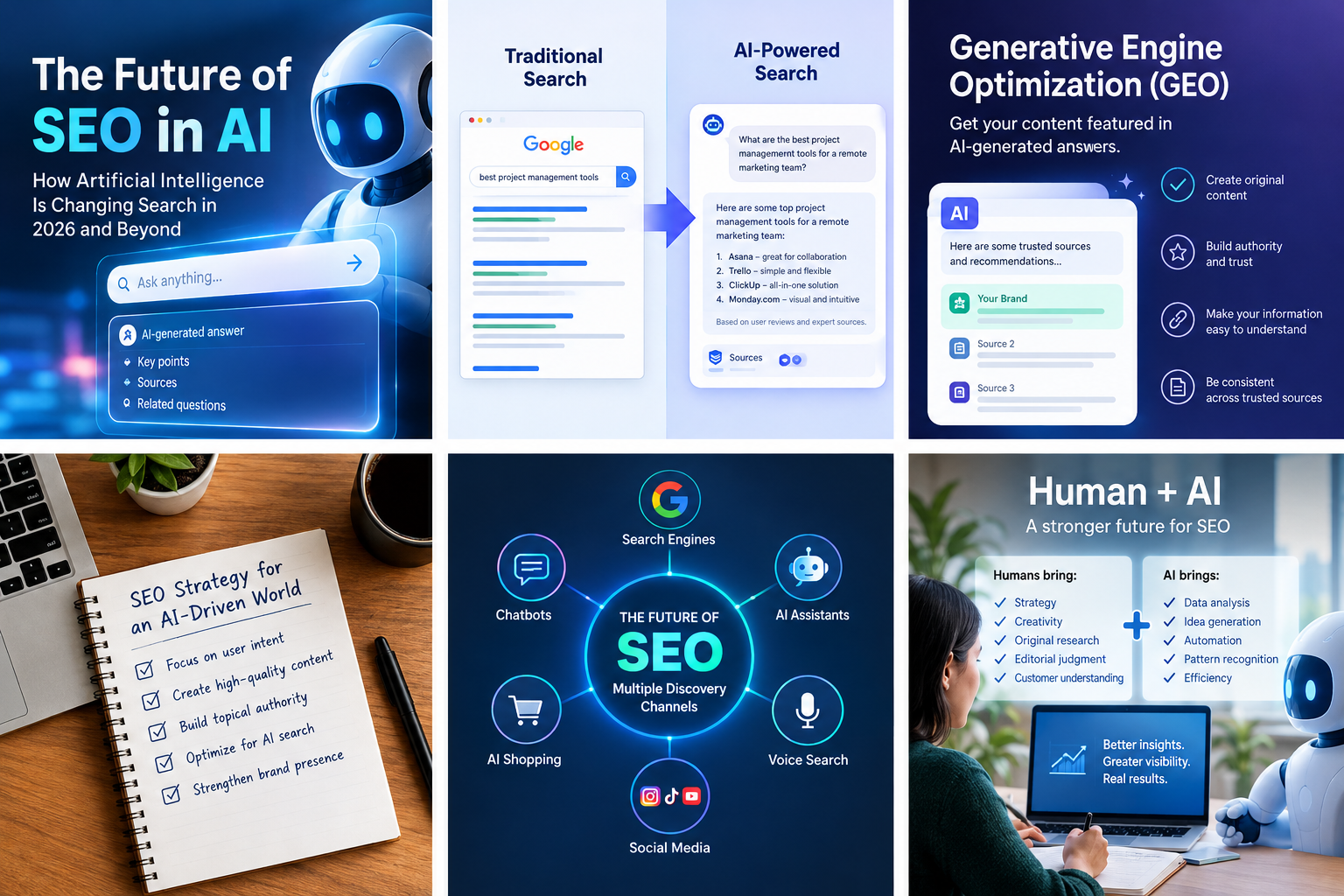
Future of SEO in AI: How AI Is Changing Search in 2026
- By Admin
- |
- 0 Comments
Search is no longer simply about typing keywords into Google and choosing a blue link. With artificial intelligence transforming how people discover information, products, services, and brands, the future of SEO is entering a completely new era. AI can understand questions, summarize information, compare sources, and provide direct answers, fundamentally changing how users interact with search.
The rise of AI-powered search means businesses can no longer rely only on traditional keyword rankings. Search visibility increasingly depends on whether content can be understood, trusted, cited, and recommended by AI systems. At the same time, generative engine optimization is emerging as an important strategy for brands that want to appear in AI-generated answers.
So, what does the future of SEO look like in 2026 and beyond? The answer is not the end of SEO. Instead, SEO is evolving into a broader discipline focused on visibility across traditional search engines, AI assistants, and answer engines.
What Is AI-Powered Search?
AI-powered search uses artificial intelligence to understand the meaning and context behind a user's query rather than simply matching individual keywords.
Traditional search might return ten website links for a query such as:
“Best accounting software for small businesses.”
An AI-powered search experience may instead provide a summarized comparison of several accounting platforms, explain their advantages, and recommend options based on the user's requirements.
This change is important for the future of SEO because users may receive an answer without visiting multiple websites. Businesses therefore need content that AI systems can understand and confidently use when generating responses.
How AI Is Changing Traditional SEO
The future of SEO will be less focused on individual keywords and more focused on topics, entities, context, expertise, and user intent.
AI systems are becoming better at understanding natural language. This means creating an article simply by repeating a keyword throughout the page is unlikely to be an effective long-term strategy.
For example, instead of creating separate pages targeting:
- “best running shoes”
- “best shoes for running”
- “top running shoes”
- “running shoes recommendations”
a business can create one comprehensive resource covering different types of running shoes, use cases, materials, fitting advice, comparisons, and expert recommendations.
This approach supports the future of SEO because it demonstrates topical depth rather than keyword repetition.
The Rise of Generative Engine Optimization
One of the biggest developments in the future of SEO is generative engine optimization.
Generative engine optimization focuses on improving the likelihood that a brand's information will be understood, referenced, or mentioned in AI-generated answers.
Imagine someone asks an AI assistant:
“What are the best project management tools for a remote marketing team?”
Instead of displaying a traditional list of links, the AI may generate a personalized answer containing several software recommendations.
With generative engine optimization, businesses aim to become one of the sources that AI systems consider when producing such answers.
Effective generative engine optimization can include creating original research, publishing authoritative content, answering specific questions clearly, strengthening brand credibility, and maintaining consistent information across trusted sources.
Will Keywords Still Matter?
Yes, but their role is changing.
Keywords will remain useful because they help search systems understand the subject of a page. However, the future of SEO will increasingly involve semantic relationships and search intent.
For example, someone searching for “digital marketing strategy” could be looking for:
- A beginner's guide
- A marketing plan
- Examples
- Tools
- Agency services
- Current trends
AI can interpret these different intentions more effectively than simple keyword matching.
Therefore, successful SEO content should answer the user's underlying question rather than simply inserting a target keyword repeatedly.
Why Original Content Will Matter More
The growth of AI-generated content creates a major challenge: the internet is becoming saturated with similar information.
This makes originality increasingly valuable in the future of SEO.
Consider two articles about e-commerce marketing. The first summarizes information already available online. The second includes original customer data, expert interviews, experiments, charts, case studies, and practical results.
The second article provides something AI cannot easily reproduce from generic sources.
For this reason, brands should focus on publishing first-hand experience, original research, expert opinions, examples, and unique insights.
E-E-A-T and Trust in AI Search
Trust will become increasingly important as AI-powered search expands.
Search engines and AI systems need reliable information, particularly for topics involving health, finance, law, technology, and other areas where inaccurate information can cause serious problems.
Businesses should demonstrate experience and expertise through author information, credible references, transparent business details, original research, and accurate content.
Strong credibility can support both traditional SEO and generative engine optimization because trustworthy sources are more valuable in an AI-driven information ecosystem.
How Businesses Can Prepare for the Future
Businesses preparing for the future of SEO should focus on several key areas.
1. Create genuinely useful content
Don't write articles solely to rank for keywords. Create resources that solve real problems and provide information users cannot easily find elsewhere.
2. Answer specific questions
AI-powered search often responds to conversational queries. Create content that directly answers relevant questions with clear explanations.
3. Build topical authority
Develop multiple interconnected resources around your core subject. This helps establish your website as a knowledgeable source.
4. Strengthen your brand
Brand recognition can become increasingly important in AI-driven discovery. Consistent information, positive mentions, expert contributions, and strong digital presence can support visibility.
5. Use generative engine optimization
Treat generative engine optimization as a complement to traditional SEO. Make important facts easy to understand, support claims with evidence, and publish content that provides genuine value.
SEO Strategies That May Become Less Effective
The future of SEO is likely to be difficult for websites that depend heavily on outdated tactics.
Keyword stuffing, mass-produced low-value articles, copied content, manipulative backlinks, and pages created only to capture search traffic may become increasingly ineffective.
For example, publishing 100 short articles that provide almost identical answers may be less valuable than publishing 20 comprehensive resources with original insights.
The direction is clear: quality, relevance, trust, and usefulness are becoming more important than content volume alone.
The Future SEO Professional: Human + AI
AI will not necessarily replace SEO professionals. Instead, it will change what they spend their time doing.
SEO professionals can use AI to analyze large datasets, identify content opportunities, generate ideas, summarize research, and automate repetitive tasks.
Humans will remain important for strategy, creativity, original research, editorial judgment, relationship building, and understanding customers.
The future of SEO will therefore likely involve a partnership between human expertise and AI capabilities.
What Will SEO Look Like in 2030?
Looking further ahead, the future of SEO may involve optimizing for several discovery environments simultaneously.
A customer could discover a company through Google, an AI assistant, a chatbot, a voice interface, a social platform, or an AI shopping tool.
This means businesses will need to think beyond traditional rankings.
The goal will be search visibility wherever customers ask questions and make decisions.
That is where AI-powered search and generative engine optimization become especially important.
Frequently Asked Questions
Is SEO dead because of AI?
No. The future of SEO is changing, but SEO remains important. Businesses still need to make their content discoverable, understandable, authoritative, and useful.
What is AI-powered search?
AI-powered search uses artificial intelligence to understand queries, context, and intent and can generate direct answers instead of simply displaying traditional search results.
What is generative engine optimization?
Generative engine optimization is the practice of creating and structuring content to improve the likelihood of being understood, referenced, or mentioned by AI-generated search and answer systems.
Will keywords disappear?
No. Keywords will continue to help search systems understand topics. However, the future of SEO will place greater emphasis on intent, context, entities, topical authority, and content quality.
How can a business prepare for AI search?
Businesses should create original and authoritative content, answer specific customer questions, demonstrate expertise, strengthen their brand presence, and adopt generative engine optimization alongside traditional SEO.
Conclusion
The future of SEO is not about choosing between traditional search and artificial intelligence. It is about adapting to both.
As AI-powered search becomes more sophisticated, users will increasingly expect direct, personalized, and conversational answers. Businesses that continue producing genuinely useful content, building authority, and understanding user intent will be better positioned to succeed.
At the same time, generative engine optimization will become an increasingly important part of digital visibility. Brands that make their expertise clear and their information trustworthy can improve their chances of being discovered across the evolving search ecosystem.
The future of SEO belongs to businesses that stop thinking only about rankings and start thinking about visibility, authority, trust, and usefulness across every place where people search for answers.
- SEO and Content Marketing
- SEO, GEO, AEO, Digital Marketing